Saturday, April 7, 2012

WHY TO VISIT TEMPLES !!!

A beautiful article...

There are thousands of temples all over India in different size, shape and locations but not all of them are considered to be built the Vedic way. Generally, a temple should be located at a place where earth's magnetic wave path passes through densely. It can be in the outskirts of a town/village or city, or in middle of the dwelling place, or on a hilltop. The essence of visiting a temple is discussed here.

Now, these temples are located strategically at a place where the positive energy is abundantly available from the magnetic and electric wave distributions of north/south pole thrust. The main idol is placed in the core center of the temple, known as "*Garbhagriha*" or *Moolasthanam*. In fact, the temple structure is built after the idol has been placed. This *Moolasthanam* is where earth’s magnetic waves are found to be maximum. We know that there are some copper plates, inscribed with Vedic scripts, buried beneath the Main Idol. What are they really? No, they are not God’s / priests’ flash cards when they forget the *shlokas*. The copper plate absorbs earth’s magnetic waves and radiates it to the surroundings. Thus a person regularly visiting a temple and walking clockwise around the Main Idol receives the beamed magnetic waves and his body absorbs it. This is a very slow process and a regular visit will let him absorb more of this positive energy. Scientifically, it is the positive energy that we all require to have a healthy life.

Further, the Sanctum is closed on three sides. This increases the effect of all energies. The lamp that is lit radiates heat energy and also provides light inside the sanctum to the priests or *poojaris* performing the pooja. The ringing of the bells and the chanting of prayers takes a worshipper into trance, thus not letting his mind waver. When done in groups, this helps people forget personal problems for a while and relieve their stress. The fragrance from the flowers, the burning of camphor give out the chemical energy further aiding in a different good aura. The effect of all these energies is supplemented by the positive energy from the idol, the copper plates and utensils in the *Moolasthan*am / *Garbagraham*. *Theertham*, the “holy” water used during the pooja to wash the idol is not
plain water cleaning the dust off an idol. It is a concoction of Cardamom,*Karpura* (Benzoin), zaffron / saffron, *Tulsi* (Holy Basil), Clove, etc...Washing the idol is to charge the water with the magnetic radiations thus increasing its medicinal values. Three spoons of this holy water is distributed to devotees. Again, this water is mainly a source of magneto-therapy. Besides, the clove essence protects one from tooth decay, the saffron & *Tulsi* leafs protects one from common cold and cough, cardamom and *Pachha Karpuram* (benzoin), act as mouth fresheners. It is proved that *Theertham* is a very good blood purifier, as it is highly energized. Hence it is given as *prasadam* to the devotees. This way, one can claim to remain healthy by regularly visiting the Temples. This is why our elders used to suggest us to offer prayers at the temple so that you will be cured of many ailments. They were not always superstitious. Yes, in a few cases they did go overboard when due to ignorance they hoped many serious diseases could be cured at temples by deities. When people go to a temple for the *Deepaaraadhana*, and when the doors open up, the positive energy gushes out onto the persons who are there. The water that is sprinkled onto the assemblages passes on the energy to all. This also explains why men are not allowed to wear shirts at a few temples and women are requested to wear more ornaments during temple visits. It is through these jewels (metal) that positive energy is absorbed by the women. Also, it is a practice to leave newly purchased jewels at an idol’s feet and then wear them with the idol’s blessings. This act is now justified after reading this article. This act of “seeking divine blessings” before using any new article, like books or pens or automobiles may have stemmed from this through mere observation.

Energy lost in a day’s work is regained through a temple visit and one is refreshed slightly. The positive energy that is spread out in the entire temple and especially around where the main idol is placed, are simply absorbed by one's body and mind. Did you know, every Vaishnava(Vishnu devotees), “must” visit a Vishnu temple twice every day in their location. Our practices are NOT some hard and fast rules framed by 1 man and his followers or God’s words in somebody’s dreams. All the rituals, all the practices are, in reality, well researched, studied and scientifically backed thesis which form the ways of nature to lead a good healthy life.

The scientific and research part of the practices are well camouflaged as “elder’s instructions” or “granny’s teaching’s” which should be obeyed as a mark of respect so as to once again, avoid stress to the mediocre brains.
— Wisdom Dawns & Shashi Madan

Thursday, March 15, 2012

Animal Sacrifice

ANIMAL SACRIFICE
(Disclaimer: The views expressed in this page are purely by the author. Quite a few strong claims have been made in it. The claims made are based purely on the author’s conviction and may not stand the strict evaluation of logic.)
Before I write about the 'tradition' of animal sacrifices in Hindu communities, let me restate one of the most interesting stories I had ever read about 'tradition'.
At some place there was one guru (teacher) who had a cat as pet in his Ashram(abode). When the guru sat down to worship each evening, the ashram cat would get in the way and distract the worshipers. So he ordered that the cat be tied during evening worship.
After the guru died the cat continued to be tied during evening worship. And when the cat expired, another cat was brought to the ashram so that it could be duly tied during evening worship.
Centuries later learned treatises were written by the guru's scholarly disciples on the liturgical significance of tying up a cat while worship is performed. (from Soul Food, Kornfield and Feldman, p. 226)
The absence of understanding the underlying reason before following any tradition could make the tradition suicidal for the society. There have been numerous occasions when something said in certain perspective has lost the perspective and only the 'catchy' part of the saying remains as a legend. And this makes the problem tougher. One of the most abused sloka(couplet)'s in 'Smd. Bhagwat Geeta' is (ch2.47) :
Karmnyevadhikaraste ma phalesu kadachana
Ma karmaphalahetrubuh ma te sangosatvakarmani
Literature: 'Your right is to work only; but never to the fruits thereof. May you not be motivated by the fruits of actions; nor let your attachment to be towards inaction.'
In many many occasions only the first part is quoted, abusing the couplet itself. Just quoting the couplet in the absence of the rest could itself be confusing. But quoting just a part of the quote is actually harmful. The second part of the couplet, 'May the non-reward not let you towards inaction', is the most important part of the couplet and is often omitted. It is very important to understand that any teaching has to be taken along with the epilogue and prologue.
Man is a gifted and refined animal. Hence and Nevertheless he has in himself many beastly qualities. Only after he has given up all these deplorable qualities can he attain/understand the creator and his creation. Let us see some of these qualities. : desire, pride, anger, greed, himsa(lit. atrocity), hypocrisy, intolerance, sorrow, happiness, attachment, fear, expectation, etc etc.
Desire: It is said in Smriti that an unrealized person on his death bed is similar to a miser! He has not realized and believes that some of the materialistic things are his own and feels helpless on his inability to take them along. He, like the miser, has not understood that whatever he thinks 'his own' is maya (illusory). The desire to possess anything, is too strong to act as an obstacle to realize that whatever we want to possess is actually an illusion.
Pride: The pride comes in mind chiefly due to the 'aham bhava'. (aham:lit. I, bhava:lit. feel). The idea that something one HAS and someone else does not have is the cause of pride. If one understands whatever he/she thinks to be 'his/her' is illusion then he can find that there is no reason one be proud of. This detaching from one's own possession is something one has to practice hard to get.
Anger: This uncontrolled emotion is has been the cause of most of human created disasters. It is said that if someone has this then you need not try hard to defeat that person. He will do it for you! One gets angry when he/she thinks that 'his'/'her' ideas were not followed. One must realize that he has the right to work not to expect. There is a nice quote : Expectation reduces joy and surprises enhance joy. Give it a moment and see if you agree with it or not.
Greed: One clings to the material things thinking that they are his ultimate possession and keeps accumulating them. Like the infinite faces of God, there are infinite ways in which the materialistic things appear. To realize what you can have forever, is the realization one needs to get and then rest all follow like the air gushes inside a box that has only vacuum. The important thing is to create the vacuum. Clear off all the materialistic feelings.
Himsa: Realization that the whole creation is by one creator is the requirement to get rid of himsa. One takes shelter of himsa only when he/she considers the other creation to be inferior to himself/herself. And he/she starts considering himself superior. He/she gets a feeling that any superior being can trouble an inferior being. The realization that all the creation is by the creator and hence he is the supreme being and by being troublesome to some weak beings, we essentially agree to be troubled, is the most essential part in become a person devoid of himsa.
Hypocrisy: Hypocrisy is the the practice of professing beliefs, feelings, or virtues that one does not hold or possess; falseness. One turns to hypocrisy when he thinks that others will only know about the outward action. But one must realize that there is exists an accountant from who nothing can be hidden.
Intolerance: One becomes intolerant when he/she realizes that his views are not adhered to/endorsed by the other party. Many a times these views are not even expressed beforehand, and sometimes they are expressed. The person who is getting irritated must pose himself the following question: How many times am I adhering to principles laid down by the creator? When I myself am seeking pardon for all the intolerable things I am
doing, what right do I have to loose my calm? The only way I have is to keep trying to make others aware of my feelings/views.
Sorrow/Happiness: One feels sad or happy, when he/she thinks that something has happened as compared to something else that is better or worse. In Bhagwat Geeta Sri Krishna says : What are you mourning for? What ever you had got, I gave it. Whatever you lost, I took it. What was yours, that you have lost? When one understands the deep meaning underlying these statements, he will be in a blissful state. Happiness and sorrow are like local minima and local maxima. Once you have reached that point, you will go towards the opposite direction. Try reaching a state when your state is given by the function f(t)=c, where t is the time and c is a constant.
Attachment: Attachment towards anything is the cause of desire to possess that. Every creation has got a definite meaning from the creator and a purpose. Being attached to that, not only creates trouble for ones own self, but also works (many cases) as a hindrance for the other. Realizing the supreme goal of creation is the way to rise above attachment.
Fear: When anyone is afraid of anything, the question I always asked is 'Why are you afraid?'. 'I do not see any reason to be afraid because on him we have faith, who SHALL not let his followers down'. I have capitalized the word 'SHALL'. Let us try to understand it very clearly that the only reason of fear is not having faith in the creator. There is a beautiful quote by J P Vaswani : Faith is not 'God might'; faith is 'God WILL'. Sometimes I think, if one does not have faith on his creator, on whom can he have faith.
Expectation: The word expectation itself derives its meaning from not having 100% faith. What does one get by expecting some result? The only thing if at all he gets in abundance is the feeling of being let down if the expected result does not result. Sri Krishna says very clearly, do your work, do not expect the result. Only because you do not have any expectation, let it not pull you towards inaction. 'karma' (work) is the duty of every individual, understand your due 'karma' and keep doing it.
There might be many more of these 'doshas' that are best parted with. But more I think on them, I come to the conclusion that all of these are connected strongly. Rather all are just different faces of the same evil. I can very easily find that if one completely parts with any of these then he/she gets rid of all others too. One might find one of these 'doshas' more clearly than others. But on thinking a bit more, it is very easy to find that all of these inter-related and parting with any one of them completely is enough to get rid of others.
The ancient sages had known about these qualities very well. And they always preached that one should clean himself of doshas. To this effect they had proposed the animal sacrifices.
Keeping first story I had cited in this article in mind, let us try to understand the basic meaning of the sacrifice and their reasons. When they had said animal sacrifice, they never meant/asked killing of living animals. But it only means killing of the
animal/beastly qualities that are within us. Each of these qualities are predominant in different animals. And for each such 'dosha' a different animal (sometimes same animal for more than one 'dosha') is attached. And when it is said to sacrifice the animal in front of god, it only means, parting with these 'doshas' in front of god, or in other words, you are making the creator your witness and then parting with the 'dosha'. Please understand that it is a pledge in front of god; a pledge to part away from 'doshas'. All these texts had as one of their chief aims the better understanding of creator and creation and hence the talk about getting rid of the beastly qualities.
It is never required to practice violence in the name of any religion. If it is, then I consider that either the religion is farce or the interpretation of the text is incorrect.
The idea is always to understand the essence of any theory as a whole. Using just mutilated parts could not only be bad but also dangerous, not only to others, but also to ourselves. It is rightly said 'Alpa Vidya Bhayankari'. (Lit: Little knowledge could be dangerous).
Let us try to see some of the qualities we had talked about and the animals attached there to.
One of the well known sacrifices is that of horse : 'Aswa Medha Yagna'. Here the king(A) who is the 'karta' of the Yagna wants to become a 'Samrat' (Supreme ruler) from 'Raja'(King). He asks few of his men to take a grandly decorated horse to all the kingdoms he wants to rule. Whichever king(B) does not allow the horse passage through his land is daring the king A to take on him in the battle field. If king A wins the battle then the horse continues its journey. If the king B is allowing the passage of the horse, it means he has agreed to be a subordinate to king A. Once the horse is back from it's journey, the king performs a grand 'Yagna'(prayer) and traditionally this horse is sacrificed! This thought tormented me for quite sometime, until I understood what lays underneath. The horse that is taken around is an actual horse, but what it symbolizes is king's pride. Whoever challenges this horse is challenging king's pride. And at the time of 'Yagna', what is sacrificed is the king's pride. Not the animal horse, but the beastly quality of pride that king has. This is a way of pledging by the king that even though he has won all the kingdoms, he is humble. Horse symbolizes pride. And by saying the horse is to be sacrificed, it is meant to sacrifice your internal pride. The horse was representing his 'desire' and 'greed' to win throughout it's journey. So when it is said that one has to sacrifice that horse, what it actually means is to get rid of your desire and greed.
Let us look at some more:
Bull: Typically attached to bull is anger. Sacrificing anger is most important for any progress. So starts the sacrifice of bull (in your mind).
Chicken: Attached to chicken is fear. That's why you see so many chickens being slain in front of Goddesses temples. Goddesses are symbolic to bravery. So you sacrifice the chicken (fear in your mind).
Pigeon: Attached to pigeon is hypocrisy. When you are asked to sacrifice pigeon in front of God, you are asked not to be a hypocrite. Open your eyes and understand the creation and the creator and have full confidence in him. Let us remember the quote by Vaswani : Faith is 'God will.'.
Cow: Attached to cow is expectation, fear and greed. It is one of the animals that has lot of expectation from others and has lot of fear. See the way it eats, you can understands why it is full of greed. There are many tribes that believed in cow sacrifice. And all they were required was to rise above expectation, greed and fear.
Goat - Same as cow.
There are many other animals which are known to be sacrificed. Please understand the meaning behind the ritual of sacrificing. And follow what does it mean, when some scripture/ritual asks for an animal sacrifice. Please understand how important it is, to sacrifice the inner animal instincts and sacrifice it, but not a living animal!
Some of you will find that there are many animals sacrificed without any requirement from the scriptures. Well this is something each human should be proud of! Yes, we are so good at working out the theories to our ease that sometimes we even surprise ourselves! Say the scripture talks about some animal sacrifice and we decide that we will actually kill that poor animal. And now we find that it is very difficult to obtain that, then we use some other innocent creature! I have heard the following proverb used at it's worse to support our claims "Something is better than nothing!". Sometimes I wonder at the sheer power of our brains!!
Let us take the same platform for one more issue in Hindu religion. I have a feeling there are similar activities in other religions too, but not 100% sure. People goto temples etc and then donate money or other materialistic things. Some people get themselves tonsured. How many of us have actually thought, why are these required? These activities have deep and profound meanings; and if followed without understanding the basics underneath them, then there is no difference between you and an atheist.
Typically people do these things because, they had promised God that they will do 'this', if their wishes are fulfilled. They keep their promises and carry out the outward actions. But what they miss is the most important part of it : The underneath theory.
Let us looks at the ritual of getting tonsured. The idea of getting tonsured is that, one is shedding away all his attachments, getting rid of pride that he might derive from his looks and going to God with a promise to part with 'aham'. But what we see now a days, is that this tonsuring business has only helped the prospering the business of hat sellers.
One more ritual that is typical in Hindus is getting tonsured when one's father expires. Please think why does one do that? It is only to tell that I am so grieved that I do not care about what my looks are. I have lost my most prized possessions. What can be more
shameful than finding the same son, putting on a fancy hat immediately the next day. If one does not have any mourning, please, please do not shave off your head.
Let me stop with a repeated request to spend a bit of time to think on the donations to temples. What does it mean to donate some materialistic things to him, who has provided everything?

-By Krishna

Tuesday, December 6, 2011

ANDAL

ANDAL
The remarkable girl who would marry none but the Lord


Andal is one of the most extraordinary personalities in religious history. She is known in her native tongue of Tamil as an Alvar, one who is "immersed" in the depths of enjoyment of God, theomnipresent mysterious One. Tradition reckons 12 Alvars, of which Andal is the only female. Between the fifth and ninth centuries, in the Tamil-speaking region of South India, these saints revitalized the Indian religious milieu, sparking a renewal of devotional worship throughout the subcontinent. Traveling from place to place, from temple to temple, from holy site to holy site, they composed exceedingly beautiful poetry to their Divine Beloved, Vishnu, as an expression of their love for Him. Anyone can see why their poetry was so attractive; at once both impassioned and philosophical, their words cut across all barriers of caste and class, attracting all to their faith. In doing so, they sculpted a new religious heritage of intensely emotional bhakti, or love of the Divine, whose impact is still felt today in the Indian religious life. Andal, whose life and poetry are celebrated every December-January, is the most visible contributor to this heritage.
[ Biography - Further Thoughts - Tiruppavai ]

Life of Andal

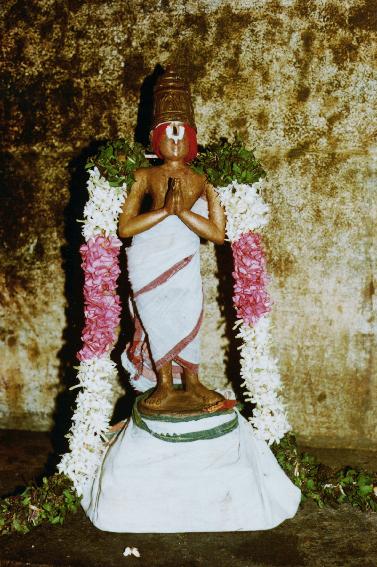
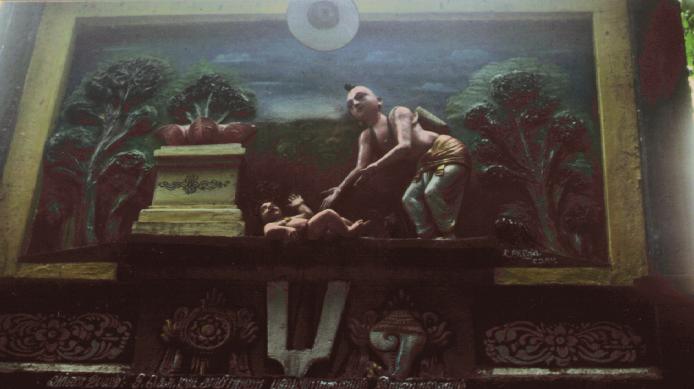
The life of Andal is remarkable in its romantic simplicity. A devout brahmin named Vishnucitta lived in Villiputtur, a town near Madurai. His daily duties included procuring

Vishnucitta discovering Andal.
Scultpure above the tulasi garden in Srivilliputtur
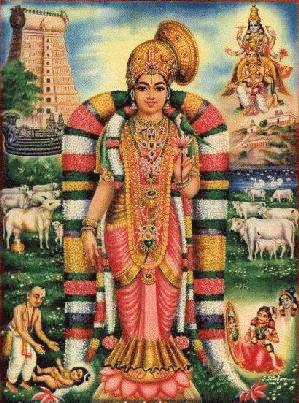
flowers for the worship of the Lord at the local temple. One morning, as he went about his business, he discovered a baby girl lying under a tulasi plant in his flower garden. Having no family of his own, Vishnucitta felt it was God's grace that gave him this child and named her Godai, or "gift of Mother Earth."Filled with joy, he took her home and raised her as his own.

Godai grew up in an atmosphere of love and devotion. Vishnucitta doted on her in every respect, singing songs to her about his Beloved Krishna, teaching her all the stories and philosophy he knew, and sharing with her his love of Tamil poetry. The love Vishnucitta had for his Beloved Lord intensified further in his daughter, and before long she was passionately in love with Lord Krishna. Even as a child, Godai made up her mind to marry none but the Lord of Brindavana, and refused to think of any human being in similar terms.

She imagined what it would be like to be His bride, playing the role of His beloved, enjoying His presence. Unknown to her father, she adorned herself daily with the flower garland he prepared for the Lord at the temple. After admiring her reflection and thinking of herself as His ideal bride, she would put the garland back for her father to take to the temple and offer to the Lord.

Traditional Painting of Andal

One day, Vishnucitta noticed a strand of Godai's hair on one of the garlands. Shocked and saddened by this desecration of what was meant only for the Lord, he scolded Godai for her misuse of the garland and discarded it. He carefully prepared a new one and offered it to the Lord, begging His pardon all the while.

That night, the Lord appeared to Vishnucitta in his dream and asked him why he discarded Godai's garland instead of offering it to Him. He told Vishnucitta that He missed the scent of Godai's body in the flowers, and that He preferred them that way. Would he please continue to give the garlands once worn by Godai? Overcome with emotion, Vishnucitta awoke and cried tears of both joy and remorse. It dawned on him that his daughter was someone whose love of God was so intense and pure that even he had not comprehended its extent. Her spiritual greatness was such that the Lord Himself wished to share her presence. From this day on, she became known as "Andal", the girl who "ruled" over the Lord.

Andal blossomed into a beautiful young woman as she came of marriageable age. When asked to marry, however, she stubbornly refused, saying that she would only agree to marry Sri Ranganatha, the Lord at the great temple town of Srirangam. Vishnucitta despaired, wondering what was to become of his daughter. One night, Lord Ranganatha appeared in his dream and asked that Andal be sent to Him in all her wedding finery. Simultaneously, the Lord appeared before the priests at Srirangam and asked them to prepare for the coming of Andal. Vishnucitta once again was filled with both joy and sadness; joy that his beloved daughter would attain her goal, but sadness

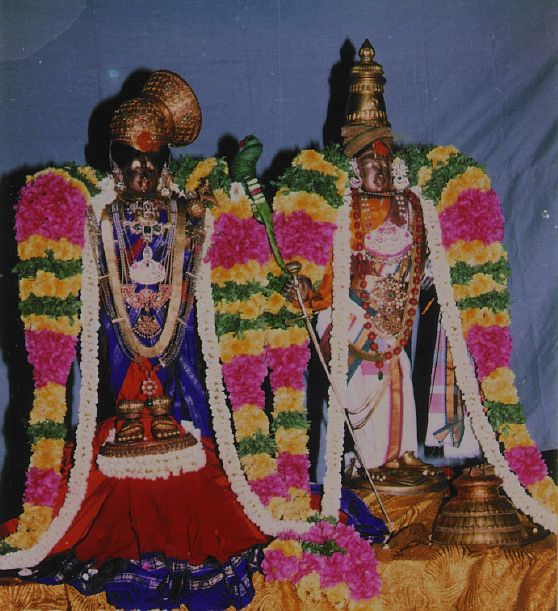
The Divine Couple: Andal and Rangan
in Srivilliputtur
at losing her at the same time. He made all the wedding preparations and arranged for Andal's journey in a palanquin to Srirangam.

Andal waited with excited anticipation as the wedding party approached Lord Ranganatha's shrine. As they entered the temple, she jumped out of the palanquin, unable to restrain herself any longer. Running into the temple sanctum, she embraced Lord Ranganatha and disappeared in a blaze of glory, having joined her Lord. She was only fifteen at the time.

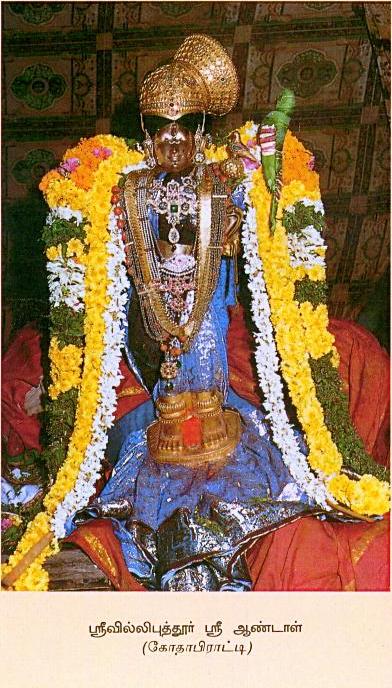
Andal is now one of the best loved poet-saints of the Tamils. Pious tradition reckons her to be the veritable descent of Bhumi Devi (Mother Earth) in bodily form to show humanity the way to His lotus feet. She is present in all Sri Vaishnava temples, in India and elsewhere, next to her Lord, as she always desired.

Historicity

The hagiography of Andal as presented above is undoubtedly historically true in most important respects. Today, the tulasi garden in which she was found is preserved in Srivilliputtur. Vishnucitta's house, adjacent to Lord Vishnu's temple, has been converted into a temple in honor of Andal and contains the well in which she admired her reflection while wearing the Lord's garlands.

Most of all, however, Andal is remembered for her poetry, in which she often strikes autobiographical notes about her love for her Lord. She describes herself as a young girl, still not fully mature, pining away for Him. She beseeches her friends, the god of love, and even animals for help in her quest to attain Him. Finally, she describes her good fortune of being the daughter of Vishnucitta, the best of the devout, who lives in Srivilliputtur and adores the Lord.

Andal's Poetry

Srivilliputtur
Andal
Andal composed two works in her short life. Both are in Tamil and are unique in their literary, philosophical, religious, and artistic content. Her contribution is even more remarkable considering that she was a teenage girl when she composed these poems, at a time when there is no other record of Tamil women composing poetry [2]. Far from being the prattlings of a youngster, Andal's verses display a literary and religious maturity far beyond her years.

Her first work is the Tiruppavai, a poem of thirty verses in which Andal imagines herself to be a cowherd girl during the incarnation of Lord Krishna. She yearns to serve Him and achieve happiness not just in this birth, but for all eternity, and describes the religious vow (pavai) that she and her fellow cowgirls will take for this purpose.

The second is the Nacciyar Tirumoli, a poem of 143 verses. Tirumoli, literally meaning "sacred sayings", is a Tamil poetic style in which the work is composed. "Nacciyar" means goddess, so the title means "sacred sayings of our Goddess." This poem fully reveals Andal's intense longing for Vishnu, the Divine Beloved. Utilizing classical Tamil poetic conventions and intermixing stories from the Sanskrit Vedas and Puranas, Andal creates imagery that is quite possibly unparalleled in the whole gamut of Indian religious literature.

The impact of these works on the daily religious life of the South Indian has been tremendous. Just like the Ramayana, people are never tired of listening to the Tiruppavai. The poem itself is recited with great religious fervor by women, men, and children of all ages, particularly in Tamil Nadu. The daily services in most Vaishnava temples and households include its recitation.

Both of these works, particularly the Tiruppavai, have been commented on extensively by innumerable scholars in a number of languages over the centuries. Today, we are fortunate to have many translations of the Tiruppavai in Western languages which make these poems available to an even wider audience.

During the month of Margali (December-January), discourses on the Tiruppavai in Tamil, Telugu, Kannada, Hindi and English take place all over India.

[ Further Thoughts ]


1. Vishnucitta is also known as Periyalvar, or "the great alvar". [Back]

2. Overall, the record of Tamil literature has been far better than any other Indian language in this respect. We know of many women poets from the (pre-Andal) Sangam period of Tamil literature. However, in the post-Sangam age, the number of women writers dwindles to almost zero. The only other woman at all close to Andal's time is Karaikkal Ammaiyar, a devotee of Siva who lived between the 5th and 6th centuries. [Back]


Saturday, October 8, 2011

Vishnu Offering His Eye in Place of the Missing Lotus (Illustration to the Shiva Purana)

Vishnu Offering His Eye in Place of the Missing Lotus<br>(Illustration to the Shiva Purana)

This painting, a pata-chitra rendered by blending the folk styles of Orissa, its palette, iconography and the style of embellishing the canvas, especially the border, and Bengal, especially its power to reveal its narrative, represents one of the lesser known legends in the Shiva Maha Purana. It relates to Vishnu's acquiring the famed Sudarshana-chakra - disc, contrary to what the common mind believes, from Shiva by his rigorous penance and unique sacrifice made in its course. The legend appears in Chapter 34 in Chaturtha Koti Rudra Samhita. The painting represents Shiva towards the upper side of the canvas with the Sudarshana-chakra in his hand, Vishnu offering his eye to Shiva-linga and a mass of lotuses strewn around the deity.

As the text has it, once gods, unable to confront some mighty demons who ousted them from Heaven and stripped them of all their powers and possessions, approached Vishnu for rescuing them from the clutches of their foes and regain their lost abode and belongings. Vishnu consoled them but also expressed his fear that he might not eliminate them as they were great warriors and exceptionally powerful. He however assured them that he would seek Shiva's blessings and with his help would surely destroy them. This revived their confidence and well assured they returned. For fulfilling gods' errand Vishnu meditated on Shiva and began thinking how to please him. Considering penance to be its most potential instrument he retired to the Himalayas and close to the Mount Kailash, Shiva's abode, made a fire-place, installed fire in it, collected fresh lotuses from the nearby Mansarovara lake, adorned with them the yajna premises, and seated by it began doing rigorous penance.

He started with ritual worship by making offerings to the Agni, reciting sacred syllables and hymns hailing Lord Shiva and praying him for his favour. This, however, did not please Shiva. Vishnu thought of other ways. He then indulged in every mode of penance but this too did not yield result. Suddenly in his mind occurred Shiva's Sahastra-nama-japa - recitation of Shiva's one thousand name-hymns. He collected one thousand lotuses with the vow to offer one lotus each time the nama-mantra - name-hymn, completed, and after so deciding resorted to the japa-rite. To test his commitment Shiva secretly removed one of his lotuses. Hence, when Vishnu completed the last hymn and with closed eyes directed his hand to pick up the last lotus, it was not found. He opened his eyes but only to find it missing. With no part of the world beyond him, Vishnu searched every inch of its space but with failure. He remembered suddenly that in hymns hailing him he was admired as 'lotus-eyed' and hence he could offer one of his eyes in place of the missing lotus. With this he removed one of his eyes and accomplished his vow by offering it. Finally, convinced with the genuineness of Vishnu's devotion Shiva appeared and gave him the Sudarshana-chakra, the weapon never to fail in achieving its target, and blessed him to succeed against gods' foes.

References - www.exoticindiaart.com

Tuesday, August 30, 2011

Shanti Mantra – Om Sahana Vavatu

शांति मंत्र

ऊं सहना ववतु
सहनौ भुनक्तु
सहविर्यम् करवावहे
तेजस्विना वधीतम् अस्तु
मा विद विशावहै
ऊं शांति शांति शांति


Om Sahana Vavatu Sahanau Bhunaktu
Sahaveeryam Karavavahai
Tejas Vinavati Tamastuma vidhwishavahai
Om Shanti Shanti Shantihi


Sanskrit to English Word Meaning:
Saha- both; nau-us; avatu- may he protect; bhunaktu-may he nourish; viryam karavavahai-may we acquire the capacity; tejasvi-be brilliant; nau-for us; adhitam- what is studied; astu-let it be; ma vidvisavahai-may we not argue with each other.

Translation:
May He protect both of us. May He nourish both of us. May we both acquire the capacity (to study and understand the scriptures). May our study be brilliant. May we not argue with each other. Om peace, peace, peace.

Brief explanation:
At the beginning of a class, the teacher and students generally recite this peace invocation together. Both seek the Lord’s blessings for study that is free of obstacles, such as poor memory, or the inability to concentrate or poor health. They also seek blessings for a conducive relationship, without which communication of any subject matter is difficult. Therefore, this prayer is important for both the teacher and the student.

Hanuman Slokam

Anjana garbha sambootham Kumaaram Brahma Charinam
Dhushta graha vinaashaya Hanumantham Upasmahe

Shri Raama dhootha Maha veera Rudra veerya samadhbhava
Anjana garbha sambhootha Vaayu putra namosthuthe

AsAdhya sAdhaka swAmin asAdhyam thava kim vaDa
Ramadootha KripAsindhoe MathkAryam sAdhaya prabho!

Dhanvantari Mantras

Om Namo Bhagavate
Vasudevaya Dhanvantaraye
Amrutha Kalasa Hasthaaya
Sarvamaya Vinasanaya
Thrilokya Nadhaya
Sri Maha Vishnave Nama

Saraswati Mantras

Sarasvathee namasthubhyam varadae kaamaroopinee
Vidyaarambam karishyaami siddhirbhavathumaesadaa

Sree vidyaroopini sarasvathi sakala kalaavalli chaaru
bimbhaadharee s(h)aradaa devi s(h)asthravalli veenaa
pusthaka dharinee vanee kamala paanee vaagdevee
varadaayaki pusthaka hasthae namasthuthe(y)

Naam Ramayan | Nama Ramayana | Raam Raamayan by Lakshman Char

Ticker

280 poems, viewed 546,191 times

Nāmarāmāyaṇam

Bālakāṇḍam: O Rāma, Who is the pure Brahman, superior to the (most) superior! O Rāma, Who is the supreme Lord, forming the nature of Kāla! O Rāma, Who is sleeping peacefully on the bed of Śeṣa (serpent)! O Rāma, Who is worshipped (or desired) by the Devas like Brahmā!1[1]

O Rāma, Who is the adornment of the lineage of the Sun! O Rāma, Who is the son and delight of the prosperous Daśaratha! O Rāma, Who increased the pleasure of Kauśalyā! O Rāma, Who is the wealth dear to Sage Viśvāmitra![2]

O Rāma, Who is the slayer of the dreadful Tāṭakā! O Rāma, Who made Mārīca and others fall down [far away]! O Rāma, Who is the protector of yajñas of Sage Kauśika (Viśvāmitra)! O Rāma, Who is the redeemer of the fortunate Ahalya![3]

O Rāma, Who greatly honoured by Ṛṣi Gautama! O Rāma, Who is extoled together by the multitude of Deva and best sages! O Rāma, Who entranced the people of Mithilā city! O Rāma, Who pleased the mind of King Janaka![4]

O Rāma, Who broke the bow of the three-eyed Śiva! O Rāma, Who was offered the Varamālā by Sītā! O Rāma, Who completed the solemn ceremony of marriage! O Rāma, Who destroyed the arrogance of Paraśurāma! O Rāma, Who is the guardian (protector) of Ayodhyā with Sīta!2[5--6]

Ayodhyākāṇḍam: O Rāma, Who is adorned by collection of innumerable virtues! O Rāma, Who is loved by the daughter of earth (Sīta)! O Rāma, Whose face is (pleasant) like the moon in the night ! O Rāma, Who was exiled in forest by the words (order) of father![1]

O Rāma, Whose feet (arrival) were announced by the dear Guha! O Rāma, Whose gentle feet were washed by him (Guha)! O Rāma, Who gave pleasure to sages led by Bharadvāja! O Rāma, Who made the Citrakūṭa hill his home![2]

O Rāma, Who was constantly thought of by Daśaratha! O Rāma, Who was entrusted by Bharata, the sone of Kaikeyī! O Rāma, Who performed His father’s Pitṛkarma!3 O Rāma, Who offered his Padukā (wooden slippers) to Bharata![3]

Araṇyakāṇḍam: O Rāma, Who sanctified the beings of Daṇḍaka forest! O Rāma, Who destroyed the wicked Virādha! O Rāma, Who was worshipped by Sage Śarabhaṅga and Sage Sutīkṣṇa! O Rāma, Who was gladdened by the favours of Sage Agastya![1]

O Rāma, Who was served by the king of vultures (Jatāyū)! O Rāma, Who stayed at the Pañcavaṭī banks! O Rāma, Who arranged the loss of Śūrpaṇakhā! O Rāma, Who destroyed the (armies) led by Khara and Dūṣaṇa![2]

O Rāma, Who followed the dear Sītā wanted! O Rāma, Who swiftly completed the destruction of Mārīca! O Rāma, Who searched for the missing Sītā! O Rāma, Who gave liberation to Jaṭāyū, the king of vultures! O Rāma, Who ate the fruits offered by Śabarī! O Rāma, Who severed the arms of Kabandha![3--4]

Kiṣkindhākāṇḍam: O Rāma, Whose feet were served by Hanumān! O Rāma, Who granted the genuflecting Sugrīva his wish! O Rāma, Who killed the haughty Vāli! O Rāma, Who sent out the monkeys as messengers! O Rāma, Who stayed with the favourable Lakṣmaṇa![1]

Sundarakāṇḍam: O Rāma, Who was constantly remembered by Hanumān, the best among monkeys! O Rāma, Who destroyed the obstructions in his way!4 O Rāma, Who sustained the life of Sītā! O Rāma, Who was calumniated by the rogue ten-headed Rāvaṇa![1]

O Rāma, Who was praised by the wise Hanumān! O Rāma, Who was presented by Sītā as (Her) protector from the crow!5 O Rāma, Who was shown the cūḍāmaṇi of Sītā (by Hanumān)! O Rāma, Who was comforted by the words of Hanumān, the best Monkey![2]

Laṅkākāṇḍam: O Rāma, Who departed to kill Rāvaṇa! O Rāma, Who was surrounded by the armies of monkeys! O Rāma, Who was worshipped by the dried-up Ocean! O Rāma, Who gave assurance of protection to Vibhīṣaṇa![1]

O Rāma, Who got the bridge of rocks constructed! O Rāma, Who beheaded Kumbhakarṇa! O Rāma, Who crushed the hordes of demons! O Rāma, Who was taken away (to Pātāla) by Ahirāvaṇa and Mahirāvaṇa![2]

O Rāma, Who cut off the ten heads of Rāvaṇa! O Rāma, Who was together extolled by demi-gods led by Brahmā and Śiva! O Rāma, Who was seen by Daśaratha situated in heaven! O Rāma, Who was delighted by the sight of Sītā![3]

O Rāma, Who was praised by the anointed Vibhīṣaṇa! O Rāma, Who climbed on to the Puṣpaka Vimāna! O Rāma, Who honoured the likes of Sage Bharadvāja! O Rāma, Who as dear as life to Bharata![4]

O Rāma, Who was the ornament of the city of Ayodhyā! O Rāma, Who was bowed upon by all His people (subjects)! O Rāma, Who sat on the throne resplendent with precious stones! O Rāma, Who was adorned by the royal anointment with a crown![5]

O Rāma, Who was respected by the families of kings! O Rāma, Who was offered the red colour by Vibhīṣaṇa! O Rāma, Who conferred favours on the families of monkeys! O Rāma, Who is the protector of all living beings! O Rāma, Who is the saviour of all worlds![6]

Uttarakāṇḍam: O Rāma, Who was together praised by the group of visiting sages! O Rāma, Who heard the (story of) birth and rise of Rāvaṇa! O Rāma, Who was pleased by the embrace of Sītā! O Rāma, Who protected the subjects with prudence![1]

O Rāma, Who abandoned Sītā, the progeny of Janaka, to the forest! O Rāma, Who arranged for the death of Lavaṇāsura! O Rāma, Who was worshipped by heaven-entered Śambūka! O Rāma, Who was delighted by his sons Kuśa and Lava!6[2]

O Rāma, Who was initiated into the Aśvamedha Yajña (sacrifice)! O Rāma, Who was communicated the time of His (return to) state of Viṣṇu! O Rāma, Who provided Mokṣa to the people of Ayodhyā! O Rāma, Who gave bliss to demi-gods led by Brahmā![3]

O Rāma, Whose form is full of brilliance! O Rāma, Who is the liberator from the bondage of transmigration (birth and death)! O Rāma, (ever) eager to establish Dharma (righteousness)! O Rāma, Who is the provider of Mokśa to those with Bhakti as the ultimate resort![4]

O Rāma, Who is the nourisher of all animate and inanimate! O Rāma, Who is the remover of all diseases of (this) world! O Rāma, Who settled in his abode of Vaikuṇṭha! O Rāma, situated in the state of eternal bliss (Nityānanda)![5]

Footnotes:

1 This composition consists of only Bahuvrīhi samāsa as adjectives and the name Rāma.

2 Alternately, O Rāma, Who is the guardian (protector) of prosperous Ayodhyā)!

3 Śrāddha or Yāga performed for ones deceased forefathers

4 Surasā, Siṁhikā and Laṅkinī were the three hurdles Hanumān faced on his way to Laṅkā, signifying Sātvikī, Tāmasī and Rājasī Māyās respectively.

5 The reference is to haughty crow, who pecked at Sītā to examine the strength of Rāma. Tulasīdāsa refers to the crow as Jayanta, the son of Indra.

6 Kuśa and Lava sang the Rāmayaṇa in the court of Rāma.

References

Poet: Lakṣmaṇācārya

Translator: Akhandanandaprasada

Submitter: Akhandanandaprasada, Animesh

Stats

Date added:2011-09-08
Last modified:2011-09-08
Views:1,551
Rate:1.32 per day

© Stutimandal 2008-06-15


Tuesday, November 30, 2010


Sarve Janaah Sukhino Bhavanthu


GAYATRIMANTRAM

Om Bhur Bhuva Suvah Tat Savithur Varenyam
Bhargo Devasya Dheemahi Dhiyo Yonah Prachodayat

Meaning: Oh Mother, who subsists in all the three Kaalas (Time: Past, Present and Future), in all the three lokas (Lokas: Heaven, Earth and Lower Regions) and in all the three gunas (Gunas - Attributes: Sathwa, Rajas and Thamas), I pray to Thee, to illumine my intellect and dispel my ignorance just as the splendorous sunlight dispels all darkness. I pray to Thee to make my intellect serene and bright and enlightened.

The Gaayathree manthra (Vedic prayer to illuminate the intelligence) is a sacred manthra, which demonstrates the unity that underlies manifoldness in creation. It is through the recognition of this unity that we can understand the multiplicity. Clay is one and the same thing, though pots of different shapes and sizes can be made from it. Gold is one, though gold ornaments can be multifarious. The Aathma (Divine Self) is one, though the embodied forms in which it resides may be many. Whatever the color of the cow, the milk is white always.

There is no object in the world, which does not have a form and a name. The Cosmos is made up of things with forms and names. While the forms are subject to constant change, the names remain unchanged. The form may change and even completely disappear but the name remains. Once we know the name, we can recognize what or whom it represents. In a large gathering, it will not be easy to trace a person merely from the description of his features. But when his name is called, he immediately responds and can be identified. Likewise, through the name of the Lord, the form of the Lord can be visualized.

Gaayathree is described as having five faces. The first is "Om". The second is "Bhurbhuvassuvah". The third is: "Thathsavithur Varenyam". The fourth is "Bhargo Dhevasya Dheemahi". The fifth is: "Dhiyo-yo nah Prachodhayaath". Gaayathree represents in these five faces the five Praanas (life forces). Gaayathree is the protector of the five Praanas in man. Gaayantham thraayathe ithi Gaayathree - "Because it protects the one who recites it, it is called Gaayathree." When Gaayathree acts as protector of the life-forces, she is known as Saavithree. Saavithree is known in the puraanic story as the devoted wife who brought back to life her husband, Sathyavaan. Saavithree is the presiding deity of the five praanas. She protects those who lead a life of Truth. This is the inner meaning.

When one's intelligence and intuition are developed by the recitation of the manthra, the activating deity is Gaayathree. When the life-forces are protected, the guardian deity is called Saavithree. When one's speech is protected, the deity is called Saraswathee. Because of the protective roles of Saavithree, Saraswathee and Gaayathree, in relation to life, speech and the intellect, Gaayathree is described as "Sarvadhevathaa-swaruupini", the embodiment of all goddesses.

It is essential to recite the Gaayathree manthra at least three times during morning, noon and evening. This will serve to reduce the effects of the wrong acts one does every day. It is like buying goods for cash, instead of getting them on credit. There is no accumulation of karmic (result of action) debt, as each day's karma (action) is atoned for that day itself by reciting the Gaayathree Manthra.
-Baba

Meaning of Gayatri Mantra

Gayatri is a Mantra(vedic hymn) which inspires righteous wisdom its meaning is that the Almighty God may illuminate our intellect which may lead us to righteous path. This is most important teaching. All the problems of a person are solved if he is endowed with the gift of righteous wisdom. Having endowed with far sighted wisdom, a man is neither entangled in calamity nor does he tread wrong path.Righteous wisdom stars emerging as soon as a methodical recitation of this Mantra is performed.

OM Almighty God

BHOOR Embodiment of vital or spiritual energy

BHUVAHA Destroyer of suffering

SWAHA Embodiment of happiness

TAT That (indicating God)

SAVITUR Bright, luminous, like and sun

VARENIYAM Supreme, best

BHARGO Destroyer of sins

DEVASYA D ivine

DHEEMAHI M ay receive

DHIYO Intellect

YO Who

NAHA Our

PRACHODAYAT May inspire

Translated it means: "O God, Thou art the giver of life, the remover of pain and sorrow, the bestower of happiness; O Creator of the Universe, may we receive thy supreme, sin-destroying light; may Thou guide our intellect in the right direction."

1. Om stands for "The Almighty God". He pervades in all the worlds viz.Bhulo-lok, bhuvah-lok and swah-lok. He is omnipresent. All this Creation.World, universe or cosmos is physical manifestation of God who pervades in each and every particle. That I am seeing Him every where. I should always remain aloof from evil thoughts and evil deeds and perform true worship of God by extending cooperation in promoting happiness, peace and beauty this universe which is his creation.

2. This(tat) i.e.: God is extremely bright(savitur) choicest (vareniyam) devoid of sin (bhargo) and divine(devasya). I am assimilating such God within me, in my conscience,. By such assimilation, I am also becoming bright, virtuous, sinless anddivine. Every moment this virtues are developing in all the pores and particles of my mind, brain and body. I am becoming one with these virtues, these characteristics of God.

3. That God may inspire (prachodayat) our(nah) intellect (dhiyo) and lead us on the righteous path. May our intellect become pious. May He lead us righteous path.On getting the righteous wisdom we may be able to enjoy celestial bliss in this life and make our life successful.We should contemplate and meditate on these three determinations slowly and gradually pausing for a moment on each word and an imaginary picture of that word should be drawn in the mind. The man gets enriched in divine elements by contemplating and meditating on this meaning of Gayatri. These sentiments are extremely powerful, encouraging, righteous and elevating.One should contemplate these feelings daily for some time. By such contemplation, the meaning of Gayatri Mantra is fully assimilated in the heart of the person. The result is that in a few date his mind gets diverted from evil deeds and he starts taking enthusiastic joy in righteous thinking and good actions. How so ever little this tendency may be in the beginning, it is almost certain that if it persists, the innerself of sadhak becomes spiritually advanced day by day and ultimate aim of life appears to have come closer and closer.

"The Gayatri Mantra does not belong to any particular sect of worship or it is not restricted to any certain community. It is universal, for the whole world. It contains in it the culture not of any particular society, but the culture of humanity. The Gayatri Mantra is a treasure and heritage that belongs to the whole of humanity without exclusion."

-Sri Sriram Sharma Acharya

All World Gayatri Pariwar USA is a non-profit organization.

Summary of the Mantra

Oh God! Thou art the Giver of Life, Remover of pain and sorrow, The Bestower of happiness, Oh! Creator of the Universe, May we receive thy supreme sin-destroying light, May Thou guide our intellect in the right direction.
Word for Word Meaning of the Mantra

Aum = Brahma ; bhoor = embodiment of vital spiritual energy(pran) ; bhuwah = destroyer of sufferings ; swaha = embodiment of happiness ; tat = that ; savitur = bright like sun ; varenyam = best choicest ; bhargo = destroyer of sins ; devasya = divine ; dheemahi = may imbibe ; dhiyo = intellect ; yo = who ; naha = our ; prachodayat = may inspire ;

Meaning of Gayatri Mantra

Rishis selected the words of various Mantras and arranged them so that they not only convey meaning but also create specific power through their utterance. Gayatri Mantra inspires wisdom. Its meaning is that "May the Almighty God illuminate our intellect to lead us along the righteous path". All the problems of a person are solved if he/she is endowed with the gift of righteous wisdom. Once endowed with far-sighted wisdom, a man is neither entangled in calamity nor does he tread the wrong path. A wise man finds solution to all outstanding problems. Only those persons who do not think correctly find difficulty and take wrong steps due to foolishness. Chanting of Gayatri Mantra removes this deficiency. The teachings and powers incorporated in the Gayatri Mantra fulfill this purpose. Righteous wisdom starts emerging soon after Jap(recitation) of this Mantra is performed.

Extracted from "The Great Science and Philosophy of Gayatri" by Shree Ram Sharma Acharya, Shanti Kunj, Hardwaar, Uttar Pradesh, India. Gayatri - by Words

Gayatri Mantra

Gayatri Devi is an incarnation of Saraswati Devi, consort of Lord Brahma, symbolising the "shakti" (strength) and "dev" (quality) of Knowledge, Purity and Virtue. Saraswati Devi is held to be the patronness of the Arts, being a poet and musician, as well as skillful composer. In the form of Gayatri Devi, with the blessings of Lord Brahma, she is believed to have given the four Vedas to mankind. The Vedas are widely considered to be the source of all true knowledge, the word "Veda" itself meaning "Knowledge". Gayatri Devi also gave to mankind the "Gayatri Mantra", also known as the "Guru Mantra" and the "Savitri Mantra", one of the oldest mantras, and generally thought of as being amongst the highest and most powerful mantras of all. This mantra is therefore often referred to as "the Mother of the Vedas". It appears in Yajur Veda - Adhyaya (Chapter) 36, Mantra (Verse) 3.

Due to its great power, the Gayatri Mantra had become, over time, the sole property of the Brahmins, who abused their power to maintain a hold of the common people. The great Hindu reformer, Swami (often called Maharishi) Dayanand Saraswati however freed the mantra from the iron clutches of those corrupt people, and thus made it freely available to the entire world. Through this, as well as various other acts, he strove to distance the Hindu community from the false beliefs and superstitions that had crept into it, and bring about a reversion to the true, Vedic faith.

The Gayatri Mantra occupies a unique place in that it has both the power of mantra and of prarthana (prayer). It is important then in considering the Gayatri Mantra to distinguish the difference between these two deceptively similar words.

A mantra may be articulate or inarticulate, or a combination of them, as with AUM. It has an inherent power, known as "Mantra shakti", which has a positive influence not due to any philosophical meaning behind the mantra, but simply due to its utterance alone (of course, "utterance" may or may not be vocal or heard - it can be silent, expressed only in the mind, or at the deepest level, heard only by the soul itself).

As explained, a pure mantra may or may not have any actual meaning or philosophical significance, its power being intrinsic to the mantra itself, and not instrumental to any meaning. A prarthana on the other hand does have a philosophical meaning behind it, and it is generally through this meaning that the prarthana has its power. Since the mantra is devoid of any kind of actual meaning, it cannot be conceptualised or visualised. This makes its understanding extremely difficult to the normal human mind, thus rendering its correct enunciation almost impossible to the untrained person. A prarthana however, having a meaning that can be comprehended through purely intellectual means, is far easier to be understood, since rational thought, unlike spiritual meditation is much more in the reach of the ordinary person. Thus, the method of prarthana is generally the form of worship used today.

The Gayatri, or Guru, Mantra possesses both the power of mantra and the power of prarthana, and thus has both an intrinsic power (ie "mantra shakti"), through its mere utterance alone, and also an instrumental power (ie "prarthana shakti"), which is derived from the exposition and understanding of its meaning and philosophical significance. The repeated and correct chanting of the Gayatri Mantra, with proper understanding of its meaning, is believed to be of the greatest good to the individual.

The Gayatri Mantra consists of fourteen words, each of which holds an important meaning...

Aum Bhur Bhuvah Swah Tat Savitur Varenyam
Bhargo Devasya Dhimahi Dhiyo Yo Nah Prachodayat

A basic translation can be given as...

Oh God, the Protector, the basis of all life, Who is self-existent, Who is free from all pains and Whose contact frees the soul from all troubles, Who pervades the Universe and sustains all, the Creator and Energiser of the whole Universe, the Giver of happiness, Who is worthy of acceptance, the most excellent, Who is Pure and the Purifier of all, let us embrace that very God, so that He may direct our mental faculties in the right direction.

The Gayatri Mantra can be broken down into six parts...

1. AUM, the Supreme name of God. A full explanation of this has been given in another article.

2. BHUR BHUVAH SWAH. These three words collectively are known as the "Mahavyahriti". They express the nature of God, and demonstrate his inherent qualities:-

BHUR

Firstly, the word Bhur implies existence. God is self-existent and independent of all. He is eternal and unchanging. Without beginning and without end, God exists as a continuous, permanent, constant entity.

Secondly, the word Bhur can also mean the Earth, on which we are born and sustained. God is the provider of all, and it is through His divine will that we our blessed with all that we require to maintain us through our lives.

Finally, Bhur signifies Prana, or life (literally, breath). God is That which gives life to all. Whilst He is independent of all, all are dependent on Him. It is God who has given us life, God who maintains us throughout our lives, and God alone who has the ability to take away our life, when He so chooses. The only permanent entity, all others are subject to His own will.

BHUVAH

Bhuvah describes the absolute Consciousness of God. God is self-Conscious as well as being Conscious of all else, and thus is able to control and govern the Universe.

Also, the word Bhuvah relates to God's relationship with the celestial world. It denotes God's greatness - greater than the sky and space, He is boundless and unlimited.

Finally, Bhuvah is also indicative of God's role as the remover of all pain and sufferings (Apaana). We see pain and sorrow all around us. However, through supplication to God, we can be freed from that pain and hardship. God Himself is devoid of any pain. Though He is Conscious of all, and is thus aware of pain, it does not affect Him. It is our own ignorance that makes us susceptible to the effects of Maya, or illusion, which causes us to feel pain. Through true devotion to God, we can be freed from the clutches of Maya, and thus be rid of pain and sorrow.

SWAH

Swah indicates the all-pervading nature of God. He is omnipresent and pervades the entire multi-formed Universe. Without Form Himself, He is able to manifest Himself through the medium of the physical world, and is thus present in each and every physical entity. In this way, God is able to interact with the Universe created by Him, and thus sustain and control it, ensuring its smooth and proer running and function.

Also, Swah symbolises God's bliss. All but God experience pain, suffering and sorrow. Devoid of all such things, God alone is able to experience supreme bliss. Happiness as experienced by humans is temporary, a transient state of mental satisfaction, which soon dissolves back into the mire of worldy troubles. Perfect, and without any form of deficiency, God alone experiences true bliss, permanent and unaffected by worldly pains and woes. One who realises God is able to join in this bliss, and thus God is able to impart true happiness to those who establish oneness with that Supreme Divinity.

The Mahavyahriti can be summed up by comparison to the word AUM itself, and through this comparison to the tripartite structure, can be compared to the essential nature of God, which differentiates Him from the other two entities recognised in that structure (namely, matter and soul), in the same way as the comparison between the three parts of the word Satchidananda, another name also used to describe God...

· BHUR Prana Earth Sat Existence

· BHUVAH Apana Sky Chit Consciousness

· SWAH Vyana Heaven Ananda Bliss

A fuller explanation of this tripartite structure ("Traita-vada") has been given elsewhere, in the discussion of the word AUM.

3. TAT SAVITUR, a reference again to God Himself:-

TAT

Literally, this word means "that", being used in Sanskrit to denote the third person. It is also mentioned in the Bhagavad Gita by Sri Krishna Himself, where He implies the selfless nature of the word. Being used in the third person, the word has implicit in it an idea of selflessness. Sri Krishna uses it to imply the selfless nature of charity (charity, or a gift, being used as an analogy for worship, in the form of action, implying that action should be preformed without regard to its fruits, but simply out of devotion and sense of duty, or Dharma).

Tat then is used here in the Gayatri Mantra to indicate that the worshipper is referring to [that] God, and that the praise being offered to God in the prayer is purely directed towards Him, without thought of gaining any personal benefit from that praise.

SAVITUR

Savita, from which Savitur is derived, is another name of God, this being the reason that the Gayatri Mantra is often known as the Savitri Mantra.

The implication of Savita is of God's status as the fountain, the source of all things. It is through His Divine Grace that the Universe exists, and so this word sums up the Mahavyahriti, by describing God's ability to create the Universe and sustain it, as well as, at the right time, bring about its dissolution.

Savita is also indicative of God's gift to mankind. Humans also have, in limited amount, the power, or shakti, of Savita. This shakti acts as an impetus in humans, and brings about the requirement for them to do something. They cannot sit idle, and are constantly searching for something to do. This is what is commonly known as the "creative urge". It is through this shakti that mankind has created art, and it is through this shakti also that scientific advances are made. The gift of Savita also gives creatures the ability of procreation. Hence, Savita can be thought of as meaning Father (or Mother) also.

Finally, it is the power of Savita that enables mankind to distinguish right from wrong, and vice from virtue. Through this ability, we are able to in some part direct our own selves, and thus, Savita imparts to us a certain self-guiding ability. Thus, by using this word in the mantra, we demonstrate that we are making efforts ourselves also, since God will not help us unless we are willing to help ourselves.

4. VARENYAM BHARGO DEVASYA. This triplet is a further description of the attributes and qualities of God, this time related, rather then to intrinsic qualities, to His functional and instrumental qualities, and through those qualities, His relationship to us, His Creation:-

VARENYAM

Varenyam signifies our acceptance of God, and can be translated as meaning "Who is worthy". Ever ready to obtain all the material riches of the world, more often than not, they are a disappointment once they have been achieved. God however is the one who, once realised and achieved, has the ability to truly satisfy. We therefore accept Him as the Highest reality, and it is to Him that we dedicate our efforts.

Varenyam can also be interpreted as signifying one who is eligible. We have chosen Him to be our Leader and our Guide. We place our all into His hands, and accept Him regardless of anything else. We place no conditions on this acceptance, as it is all out of sheer devotion.

BHARGO

Bhargo is taken to signify the Glorious Light that is God's love and power. It indicates His complete purity.

Being absolutely pure Himself, God also has the ability to purify those that come into contact with Him. Thus, Bhargo is indicative of God's power to purify, and to destroy all sins and afflictions. In the same way as a metal ore placed into a fire will yield the pure metal, by merging with God, by realising His Divine Form and establishing unity and oneness with Him, we can cleanse ourselves and be made pure by His Grace.

Though the soul, being itself Divine in nature, possesses that Light, it lacks lustre, having been made impure by the sins and vices, which are a result of the darkness of Maya. By removing the veil of Maya, and cleansing our soul, God can enable the soul to realise its true, Divine self, and thus purify it.

DEVASYA

The word Deva, from which this word is derived, has been translated by different people in many different ways. It is generally thought of as meaning simply "God". However, its meaning is more complex than that.

Deva, which forms the root of the words "Devata" and "Devi", means "quality" or "attribute", and can be thought of as another word for "Guna". Thus it is that the various Forms of God are given this name, as each of those Forms is related to a specific quality and function (for example, Brahma has the quality of Creation, Kamadeva has the quality of love, etc.). Also, Deva is thus used to describe anyone who is considered to possess a special quality.

Since Deva is symbolic of the individual qualities of God, the word demonstrates the inherent oneness of those different Forms, and thus the use of this word can be taken as describing the fundamental unity of God. Thus we see that here, we reaffirm that central belief in the Hindu Dharma that "Ekam sat viprah bahudah vadanti" (Truth, or God, is one, but wise men call Him/It by diffeerent names).

Thus, Deva is indicative of the various multifaceted entity that is the absolute Personality of God. It describes in one word all the functions, roles and different attributes of God, and symbolises therefore his absolutely essential nature - without God, nothing can exist.

5. DHIMAHI, meaning to meditate and focus the mind on God.

Meditation on God implies that we remove all other thoughts from our mind, since thoughts of the world render our mind impure, and thus we are unable to conceptualise the absolute purity of God. We must be able to concentrate, and direct our mental energies towards the task in hand - ie communion with God. In this, we demonstrate that God is the most important thing to us, and that we value Him above all else.

6. DHIYO YO NAH PRACHODAYAT.

Prayer is carried out for four main reasons:

· to praise and glorify God;

· to thank God;

· to ask forgiveness from God;

· or to make a request from God.

Having carried out the other three parts (praise of His greatness, thanks for His generosity in Creation and maintaining us through our lives, and forgiveness by demonstrating our awareness of our own impurity, which we have realised is present and must be cleansed through contact with God), this part is now our request from God. Since our soul is the Light of Life within us, and that acts on our body via the medium of the brain, we ask God to make this contact pure and righteous. The soul is of course inherently pure, being itself Divine in nature. The body is under the complete control of the mind. The link is the mind, which is affected not only by the soul, but also the outside world. We ask in these four words that God help us to improve our intellect, and guide it towards what is right.

DHIYO

Sanskrit for "intellect", this is the essence of this part of the Gayatri Mantra. Having firmly set God in our hearts, we now must try to emphasise His presence and influence on our mind and intellect.

Material prosperity holds no true meaning for the person who is truly devoted to God. Pain and suffering are of no consequence to him as, touched by God, he is imbued with God's own Divine Bliss, and all worldy sorrows pale to nothingness in comparison. However, still the individual must live in the world. Thus, it is important that the person's intellect remains focussed on serving God, and that it is able, through the medium of the body, to serve God to the best of its ability.

Physical objects can be obtained very easily, if one is intelligent enough to know how to go about it. Intellect however cannot be obtained, but must be there from the very first. It is by use of this intellect, in fact, that one is able to cultivate all other qualities (building of wealth, "success" in life (in material terms), physical fitness, etc.) Thus, intellect is the key to all else in life, and as such, it is the most important possession. We ask God in the Gayatri Mantra to gift us with the highest intellect, and to help us by showing us the way to use that intellect.

YO

Meaning "Who" or "That", Yo signifies yet again that it is not to anyone else that we direct these prayers, but to God alone. Only God is worthy of the highest adoration, only God is perfect and free from all defects. It is That God to Whom we offer these prayers.

NAH

Nah means "Ours", and signifies the selflessness of the request we make of God in this part of the Gayatri Mantra. We offer this prayer, and make the request of God, not simply for ourselves, but for the whole of humanity. We seek the uplift of the whole of society. Hindu philosophy has since the beginning recognised the concept of "Vasudhaiva Kutumbakam" - "The whole world is one big family". Thus, we pray not only for ourselves, but for each and every member of that great family, that we may all benefit from the greatness and generosity of the All-loving God.

PRACHODAYAT

Prachodayat, the final word of the Gayatri Mantra, rounds off the whole mantra, and completes the request we make of God in this final part. This word is a request from God, in which we ask Him for Guidance, and Inspiration. We ask that, by showing us His Divine and Glorious Light (cf. BHARGO), He remove the darkness of Maya from our paths, that we are able to see the way, and in this manner, we ask Him to direct our energies in the right way, guiding us through the chaos of this world, to find sanctuary in the tranquility and peace of God Himself, the root of all Happiness, and the source of true Bliss.

Just came across this interpretation for Gayathri mantra.
Gayatri Mantra: A scientific view - Dr Tanmaya

Gayatri mantra has been bestowed the greatest importance in Vedic dharma.This mantra has also been termed as Savitri and Ved-Mata, the mother of the Vedas. The literal meaning of the mantra is:

O God! You are Omnipresent, Omnipotent and Almighty. You are all Light. You are all Knowledge and Bliss. You are Destroyer of fear, You are Creator of this Universe, You are the Greatest of all. We bow and meditate upon Your light. You guide our intellect in the right direction.

The mantra, however, has a great scientific import too, which somehow got lost in the literary tradition. The modern astrophysics and astronomy tell us that our Galaxy called Milky Way or Akash-Ganga contains approximately 100,000 million of stars. Each star is like our sun having its own planet system. We know that the moon moves round the earth and the earth moves round the sun along with the moon. All planets round the sun. Each of the above bodies revolves round at its own axis as well. Our sun along with its family takes one round of the galactic centre in 22.5 crore years.

All galaxies including ours are moving away at a terrific velocity of 20,000 miles per second.

And now the alternative scientific meaning of the mantra step by step:
(A) Om bhur bhuvah swah:
Bhur the earth, bhuvah the planets (solar family), swah the Galaxy. We observe that when an ordinary fan with a speed of 900 RPM (rotations Per minute) moves, it makes noise. Then, one can imagine, what great noise would be created when the galaxies move with a speed of 20,000 miles per second. This is what this portion of the mantra explains that the sound produced due to the fast-moving earth, planets and galaxies is Om.

The sound was heard during meditation by Rishi Vishvamitra, who mentioned it to other colleagues. All of them, then unanimously decided to call this sound Om the name of God, because this sound is available in all the three periods of time, hence it is set (permanent). Therefore, it was the first never revolutionary idea to identify formless God with a specific title (form) called upadhi. Until that time, everybody recognized God as formless and nobody was prepared to accept this new idea. In the Gita also, it is said, "Omiti ekaksharam brahma", meaning that the name of the Supreme is Om, which contains only one syllable (8/12). This sound Om heard during samadhi was called by all the seers nada-brahma a very great noise), but not a noise that is normally beyond a specific amplitude and limits of decibels suited to human hearing. Hence the rishis called this sound Udgith musical sound of the above, i.e., heaven.They also noticed that the infinite mass of galaxies moving with a velocity of 20,000 miles/second was generating a kinetic energy = 1/2 MV2 and this was balancing the total energy consumption of the cosmos. Hence they named it Pranavah, which means the body (vapu) or store house of energy (prana).

(B) Tat savitur varenyam:
Tat that (God), savitur the sun (star), varenyam worthy of bowing or respect. Once the form of a person along with the name is known to us, we may locate the specific person. Hence the two titles (upadhi) provide the solid ground to identify the formless God, Vishvamitra suggested. He told us that we could know (realize) the unknowable formless. God through the known factors, viz., sound Om and light of suns (stars).A mathematician can solve an equation x2+y2=4; if x=2; then y can be known and so on. An engineer can measure the width of a river even by standing at
the river bank just by drawing a triangle. So was the scientific method suggested by Vishvamitra in the mantra in the next portion as under:-

(C) Bhargo devasya dheemahi:
Bhargo the light, devasya of the deity, dheemahi we should meditate. The rishi instructs us to meditate upon the available form (light of suns) to discover the formless Creator (God). Also he wants us to do japa of the word
Om (this is understood in the Mantra). This is how the sage wants us to proceed, but there is a great problem to realise it, as the human mind is so shaky and restless that without the grace of the Supreme (Brahma) it cannot be controlled. Hence Vishvamitra suggests the way to
pray Him as under:

(D) Dhiyo yo nah prachodayat:

Dhiyo (intellect), yo (who), nah (we all), prachodayat (guide to right Direction). O God! Deploy our intellect on the right path. Full scientific interpretation of the Mantra: The earth (bhur), the planets (bhuvah), and the galaxies(swah) are moving at a very great velocity, the sound produced is Om, (the name of formless God.) That God (tat), who manifests Himself in the form of light of suns (savitur) is worthy of bowing/respect(varenyam). We all, therefore, should meditate (dheemahi) upon the light (bhargo) of that deity (devasya) and also do chanting of Om.
May He (yo) guide in right direction (prachodayat) our (nah) intellect dhiyo So we notice that the important points hinted in the mantra are:-
1) The total kinetic energy generated by the movement galaxies acts as an umbrella and balances the total energy consumption of the cosmos. Hence it was named as the Pranavah (body of energy). This is equal to 1/2 mv2 (Mass of galaxies x velocity2).

2) Realising the great importance of the syllable OM, the other later date religions adopted this word with a slight change in accent, viz., amen and Ameen.

3)The God could be realised through the saguna (gross), upasana (method), i.e., a) by chanting the name of the supreme as OM and b) by meditating upon the light emitted by stars (suns).

AdiyEn
Lakshmi Narasimhan

References - http://www.mypurohith.com/Rituals/Gayatrimantram.asp